Girls Basketball Participation Is Declining — And Team Camps May Be Part of the Answer
The numbers tell a clear story. Here's what the research says about what's driving girls away from the game, and what actually brings them back.
Across the country, girls basketball programs are facing a common challenge: participation numbers are declining. While there is no single solution, team camps provide opportunities for competition, team building, and program engagement that can help athletes stay connected to the game. For coaches and communities looking to strengthen their programs, these experiences may be more important than ever.
So why are fewer girls actually playing?
Beneath the highlight reels, a quieter trend is playing out at the high school level — one that coaches, athletic directors, and parents need to understand. Girls' high school basketball participation has been declining for over two decades, and the gap between the sport's cultural visibility and its actual participation numbers is growing wider every year.
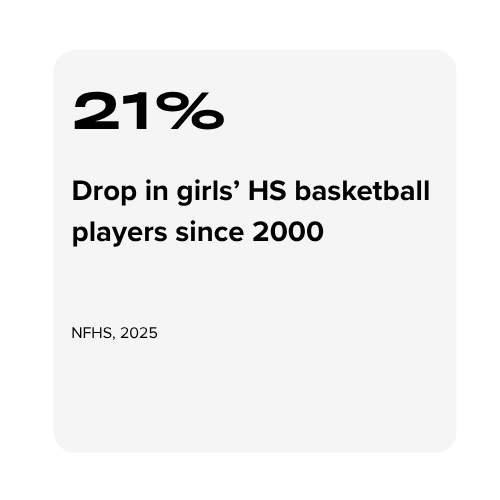
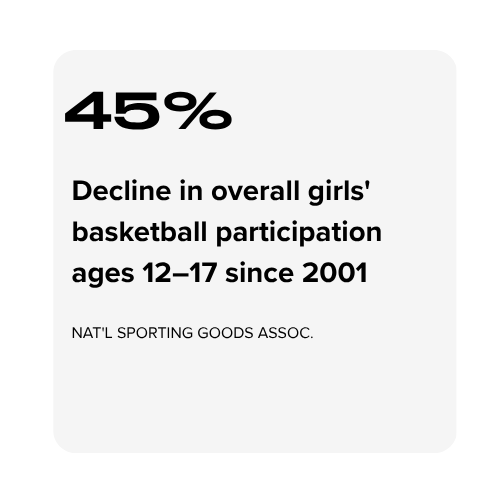
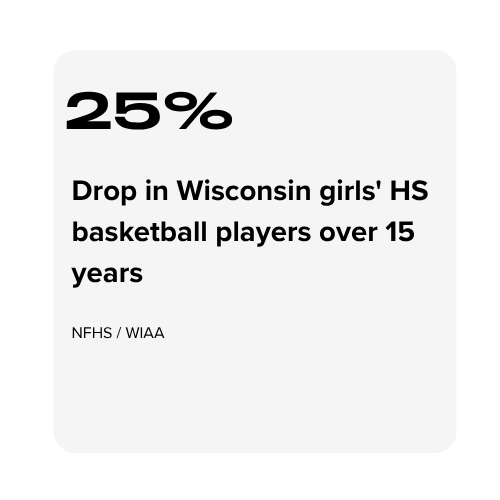
These aren't outlier numbers from one region. The National Federation of State High School Associations (NFHS) reports that girls' high school basketball participation fell from 451,600 players in 2000 to 356,240 in 2025 — even as more schools were reporting data. The National Sporting Goods Association's numbers are starker still: overall basketball participation for girls ages 12–17 dropped from 3.1 million in 2001 to 1.7 million in 2024. National governing bodies have raised alarms, and state athletic associations from Wisconsin to Montana are watching the same downward trend play out locally.
This is a national problem. And it deserves a serious look at what's actually driving it — and what works to reverse it.
Why girls are leaving the game
The Women's Sports Foundation has studied this question extensively, and the barriers are both structural and experiential. As girls move through adolescence, the quality of their sports experience often declines relative to their male peers — facilities, coaching resources, equipment funding, and practice times frequently lag behind boys' programs. The experience, in short, stops being fun.
Cost is a compounding factor. School sports budgets have been cut repeatedly across the country, shifting the financial burden onto families. Research consistently shows that low-income girls face the highest barriers: only one in four low-income girls participates in organized sports at all, according to data from the Aspen Institute's State of Play report.
But there's a subtler force at work too — one that doesn't show up easily in budget line items. Girls who don't feel connected to their team are more likely to quit. The experience of belonging, of mattering to a group, is not a soft benefit. It is one of the primary reasons young athletes stay in sports — or walk away.
"Sports participation helps enhance self-image, build confidence, and develop social and interpersonal skills — but only when the experience is one worth staying for."
— Women's Sports Foundation
What keeps girls in the game
The research on youth sports retention points consistently in one direction: belonging matters more than winning. Athletes who feel genuinely connected to their teammates, who have relationships that extend beyond practice, and who experience their team as a community rather than just a roster — those athletes stay.
This is precisely where team camps, and specifically pre-season team camps, have an outsized impact that individual skill development cannot replicate. The high school transition is a critical window: new players are joining rosters, returning players are navigating new roles, and the relational foundation of the season is being laid. A team camp at this stage gives that process somewhere to happen — outside the pressure of competition, in an environment designed for connection.
The camaraderie built at a team camp — through shared experiences, team interaction, and time spent together outside of competition — creates the sense of belonging that research consistently links to athlete retention.
Communities across Oregon face many of the same participation challenges seen nationwide. Smaller schools and rural programs often have fewer opportunities for off-season competition, making team camps and organized summer events an important part of keeping athletes connected to their teammates and their sport. Creating opportunities for players to compete together outside the regular season can help strengthen both individual programs and the broader girls basketball community.
What Long-Term Team Investment Can Build
Consider the trajectory of a small-town team that committed to playing together year-round from grade school onward — team camps, weekend tournaments, consistent investment in being together beyond the regular season. By their senior year, that accumulated trust had compounded into something measurable: a state basketball title, with several players also winning state in other sports. The camp and tournament fees along the way were the least expensive part of what that team built together.
The team camp gap — and why it matters now
Here is the compounding problem: at the exact moment girls' basketball needs more reasons for young athletes to stay engaged, one of the most effective tools for building that engagement is disappearing. Genuine team camps — not individual skill showcases, but structured experiences for entire rosters — have become increasingly rare, particularly for high school girls' programs.
Most of what remains in the camp market skews toward individual skill development. That has its place. But it leaves a real gap for the teams that need something different: a space to become a team before the season starts.
Coaches who recognize this gap — and invest in filling it — are giving their rosters something no amount of individual drilling can provide: a reason to show up for each other, not just for the game.
What the Research Tells Coaches
Girls high school basketball participation has declined more than 20% since 2000.
Team connection and belonging are among the strongest predictors of long-term participation.
The transition into high school is a critical period for athlete retention.
Team camps help build relationships and culture before the regular season begins.
Structured summer competition provides opportunities for development, engagement, and team growth.
Quality team camp opportunities have become increasingly limited, making them more valuable for programs seeking meaningful off-season experiences.
The cultural moment for women's basketball has never been better. The question is whether the infrastructure around the game — the camps, the programs, the investments coaches make before the first tip-off — matches the opportunity. For teams willing to invest in being together before the season starts, the research suggests the return is significant.
While no single event can reverse participation trends, providing athletes with opportunities to compete, develop, and build relationships remains an important part of sustaining healthy basketball programs. Team camps continue to offer a valuable environment where athletes can stay engaged with the game while strengthening connections with their teammates and communities.
For Oregon coaches looking for structured summer basketball opportunities, team camps can provide a valuable environment for competition, development, and team building before the regular season begins
Now registering
Northwest Girls Team Camp
June 26–28 · Amity High School, OR · Open to all high school girls teams
Sources: National Federation of State High School Associations (NFHS) Participation Survey 2025; National Sporting Goods Association; Aspen Institute State of Play 2024 & 2025; Women's Sports Foundation; WIAA; Montana High School Association.